Last Updated on July 14, 2026 by Staff
A bumble bee carries a brain smaller than a sesame seed. That speck of tissue just cleared a challenge once reserved for chimps and people.
Bees in a Finnish laboratory reached a sugary treat that sat above their heads, out of reach. Nobody had trained them for the trick, and the reward hung well past their grasp.
The experiments ran at the University of Oulu in Finland. The University of Helsinki joined the effort.
So did the University of Turku. Together their bees cracked a task long thought to need a much bigger mind.
The box and banana test
More than a century ago, a psychologist named Wolfgang Köhler set a banana just past a chimpanzee’s reach. He scattered a few boxes nearby and waited to see what the animal would do.
The chimps stacked the boxes and climbed up to the fruit. That sudden jump to an answer became a classic sign of insight.
Those experiments grew into some of the most influential ever run on animal minds. They hinted that a creature could grasp a problem whole and act with a clear purpose.
For a long time, puzzles like this went only to big-brained animals. Insects almost never made the list.
Building a puzzle for bees
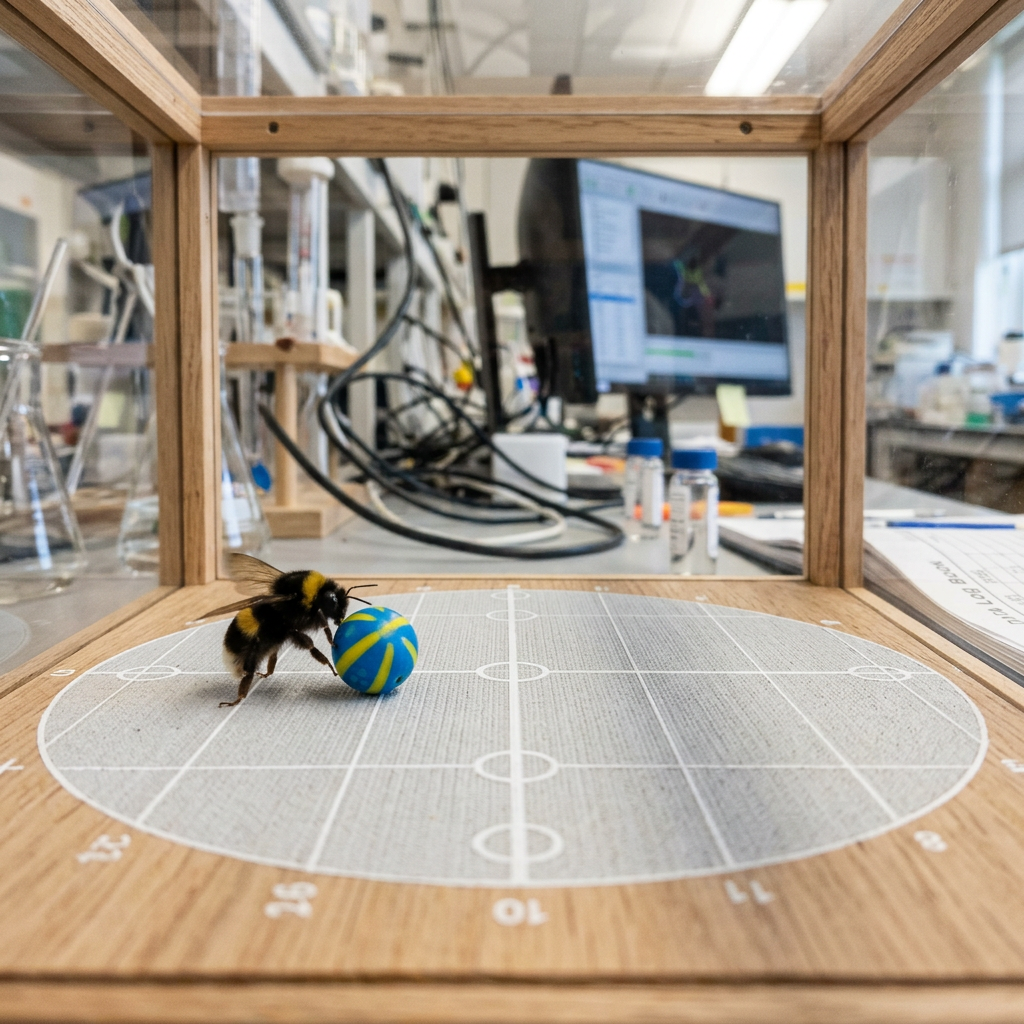
Olli Loukola wanted to see whether a bee could pull off the same feat. He built a miniature version of Köhler’s setup, scaled down for an insect that could otherwise just fly away.
His team first taught bumble bees that a blue artificial flower carried a sweet reward. They also let the bees shove a small ball around until the object seemed harmless and familiar.
The arena was a shallow dish about four inches across (10 centimeters) and only 1.3 inches tall (3.2 centimeters). The bees could walk inside but could not fly.
Then the flower rose to the ceiling of the dish. The reward now hung too high to touch from the floor.
A ball becomes a step
The bees held two separate scraps of knowledge and no instructions for joining them. Many of them joined the two anyway.
“This is essentially an insect version of the classic ‘box-and-banana’ problem,” says Olli Loukola, a docent at the University of Oulu.
“The animal must realize that an object can be repositioned and then used as a tool to reach an otherwise inaccessible goal. What stands out about the result is that this kind of spontaneous problem-solving is now demonstrated in an insect,” Loukola says.
So a bee would nudge the ball across the floor and park it beneath the blue flower. Then it climbed on top and stretched up to the prize.
Doing it without training
Nearly three-quarters of the bees reached the reward in the end. The same pattern turned up in bee after bee.
“What makes this behavior especially remarkable is that the bees had never been trained to roll the ball. This was a completely new challenge,” says Akshaye Bhambore, the study’s lead author.
“Their behavior appeared goal-directed with successful individuals showing more directed movement patterns,” Bhambore says.
Some bees solved it fast, while others fumbled the ball and needed more tries. The ones that struggled usually kept at it until the ball finally sat in place.
Ruling out luck and reflex
A doubter might guess the bees simply blundered into the answer. The team shared that worry and pushed the test harder.
They ran three versions of the challenge, each one tighter than the last. Every version stripped away another easy shortcut the bees might lean on.
“Another important aspect is that our bees were fully naive,” Loukola says.
“In many previous studies of insight-like problem-solving, the animals have had extensive experience with objects, test environments, or other problem-solving tasks,” Loukola adds.
“Here, the bees had never been trained to use the ball to reach the flower, and they had no previous experience with this kind of solution. We also designed the experiments to rule out simpler explanations such as accidental success, play behavior, trial-and-error learning, or direct visual guidance.”
Hiding the goal from view
The toughest version hid the flower completely while a bee moved the ball. It could not simply aim toward something in plain sight.
The ball now started between two screens that blocked the bee’s view of the goal. The insect had to steer it toward the correct side and then beneath the hidden flower.
Even blind to the target, the bees pushed the ball to the right place.
“By analyzing the bees’ behavior across unusually stringent control experiments, we could show that they were not simply reacting to visual stimuli or moving the ball randomly,” Bhambore says.
Surprising even to the team
The team filmed every run and studied the footage closely.
“One moment the animal is exploring seemingly without direction, and the next it performs a highly efficient sequence of actions leading directly to the solution,” says Ece Nur Akmeşe of the University of Helsinki.
“Watching the bees solving the task was genuinely fascinating,” Akmeşe says.
Bees are small, quick, and hard to track with any precision. That practical hurdle has slowed this kind of work for years.
What tiny brains can do
The result joins a growing body of evidence about bee minds. Bees can learn from one another, crack puzzles, and change their tactics when they must.
“We are not claiming that bees think like humans,” says Loukola, now a senior researcher at the University of Turku.
“But our findings show that miniature brains can generate flexible solutions to novel problems in ways we are only beginning to understand,” Loukola says.
The same flexibility may serve bees out in the wild. Flowers shift and fade across a season, so a mind that adapts can keep on finding food.
Insects join the conversation
“For over a century, spontaneous object-based problem-solving has mostly been studied in vertebrates,” Loukola says.
“Our study suggests insects may belong in that conversation too,” Loukola says.
The finding stretches the boundary of where insight can show up in nature. It seats a fuzzy, sesame-seed brain in company once limited to apes, elephants, and crows.
The study is published in the journal Science.