Last Updated on June 4, 2026 by Staff
A routine research trip to Florida’s Everglades National Park led scientists to a find about how physics affects animal behavior. Researchers from Kiel University in Germany were studying box jellyfish when they noticed something. After a rainstorm jellyfish that were usually near the water’s surface had suddenly moved to deeper waters.
The scientists were surprised because these jellyfish are known to swim towards sunlight.
Their sudden movement away from the surface seemed to go against their behavior.
This unexpected observation sparked an investigation that would show an invisible force affecting the movement of aquatic animals.
The findings, published in the Journal of Experimental Biology suggest that physical barriers within water can sometimes be more powerful than an animals instincts or swimming abilities. The species involved in the study was Tripedalia cystophora, a box jellyfish.
The Hidden Layer
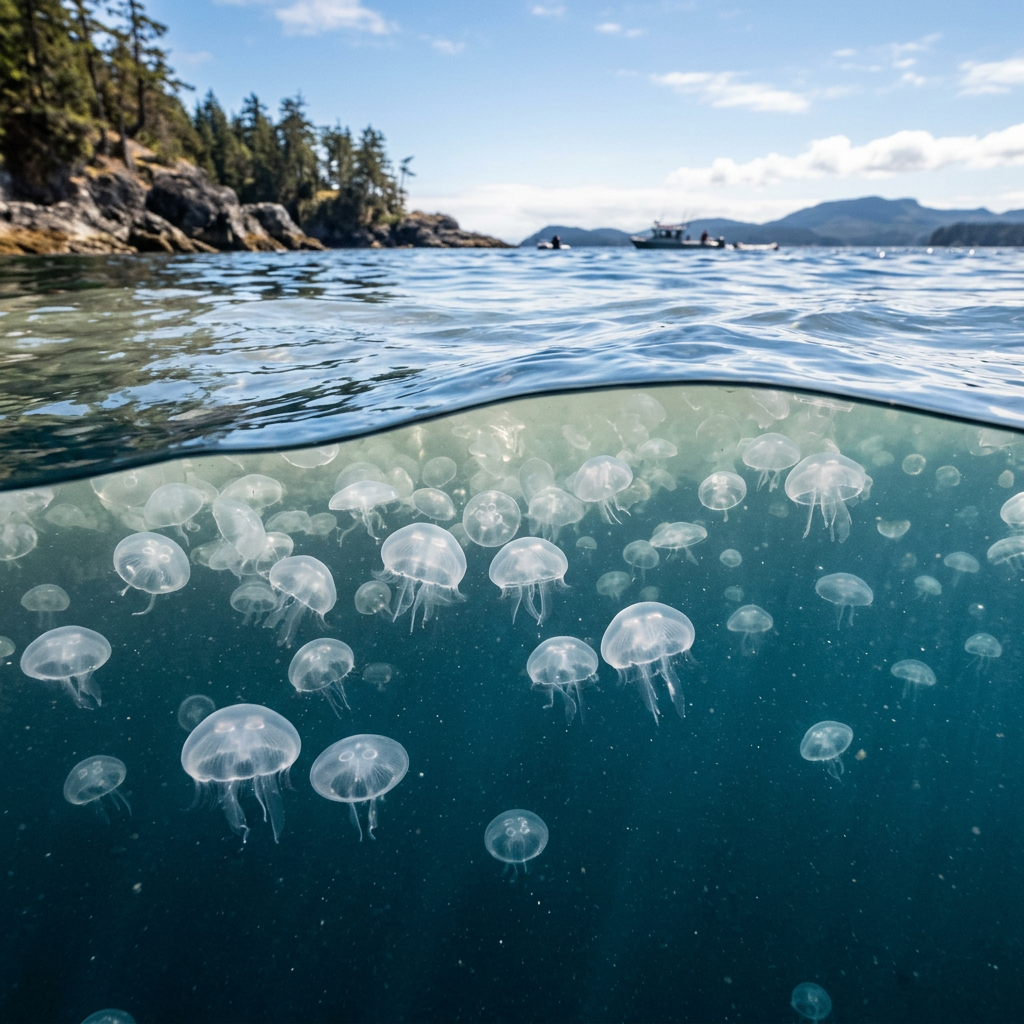
Following rainfall the environment changes dramatically. Freshwater from rain is lighter than saltwater. Forms a separate layer on top. Between the freshwater and the denser saltwater lies a transition zone known as a halocline, where salinity changes rapidly. Scientists suspected this invisible boundary might be stopping the jellyfish from reaching the surface. To test their theory they recreated the conditions in a laboratory setting.
Testing the Barrier
Back at Kiel University researchers built a halocline inside a dark laboratory tank. They then introduced jellyfish below the boundary. Placed a light source above the water to encourage the animals to swim upward.
The results were striking. Despite trying to move toward the light the jellyfish were unable to cross the halocline. Advanced cameras and AI-assisted tracking systems recorded their movements. Confirmed that the boundary effectively blocked their progress.
Researchers observed that the jellyfish kept trying to swim but consistently failed to break through the invisible layer. This showed that the barrier was not simply altering their behavior. Something else was preventing their movement.
The findings challenged assumptions about how aquatic animals interact with different water layers.
Physics Takes Over
Until now scientists believed that animals either avoided haloclines intentionally or became temporarily weakened by changes in salinity. However the new study revealed an explanation. As the jellyfish tried to swim they pushed denser saltwater into lighter freshwater. This process created a force known as stratification drag. Unlike water resistance this drag increased energy loss and reduced the animals buoyancy.
As a result the jellyfish faced greater resistance than expected. The layered water itself acted as an obstacle stopping them from crossing the boundary despite their continued effort. Researchers concluded that the jellyfish were not being limited by their biology, physiology or behavior. Instead they were being stopped by the properties of the water.
This discovery highlights the powerful role physics can play in shaping the movement of living organisms.
Why It Matters
The implications of the study go beyond jellyfish. Similar water layers exist in oceans, lakes, estuaries and coastal ecosystems around the world. Understanding how these invisible boundaries affect animal movement could help scientists predict where species live and how they respond to changes.
The researchers also noted a connection to electronics. Just as electronic interfaces control the movement of signals, haloclines act as natural interfaces that determine what can and cannot pass through them.
As climate change continues to alter rainfall patterns and water conditions such barriers may become increasingly important in shaping aquatic ecosystems. The study suggests that the distribution of animal populations can sometimes be controlled by the laws of physics rather than by the animals own decisions. By revealing how density-driven boundaries influence movement the research opens opportunities for studying the relationship between physics, ecology and animal behavior. It also reminds us that invisible forces in nature can have an impact on life, beneath the water’s surface.