Last Updated on June 12, 2026 by Staff
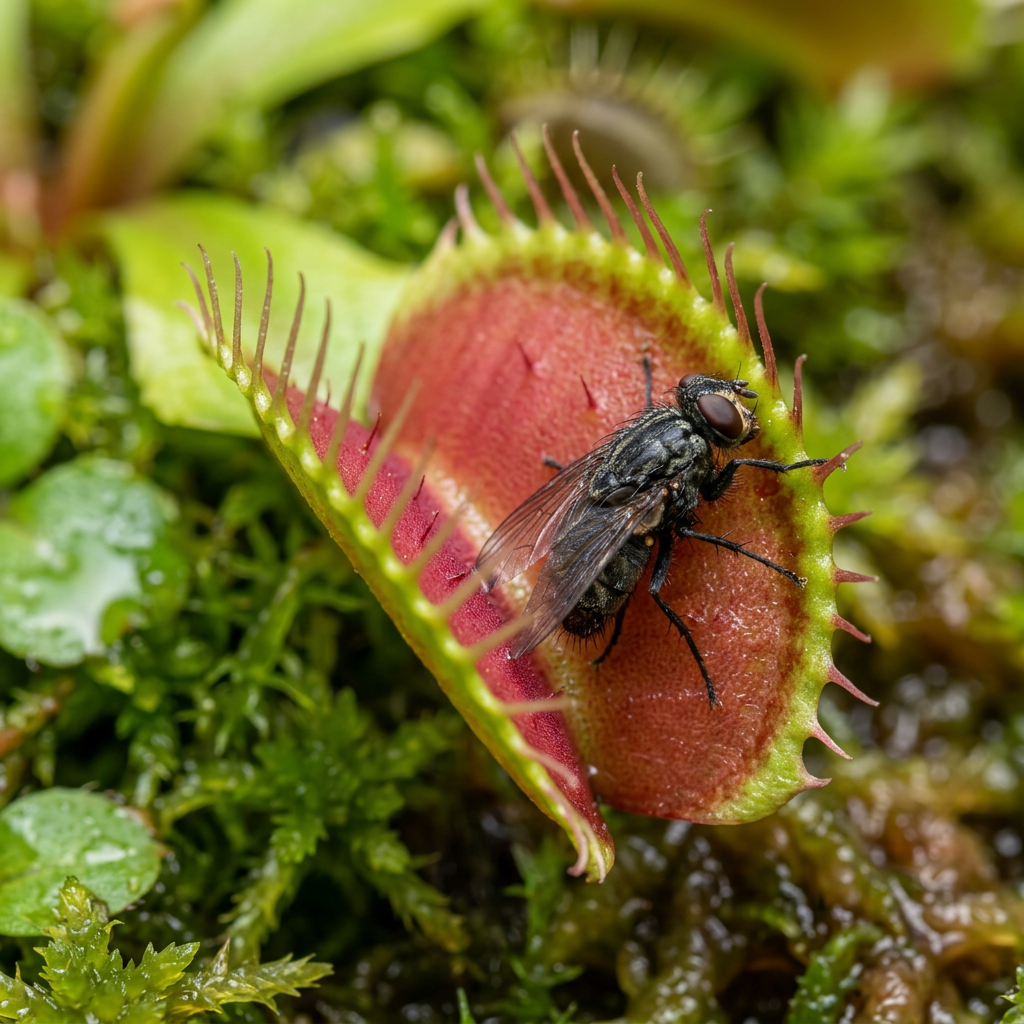
The Venus flytrap is one of the fascinating plants on Earth. This plant is really cool because it does not just depend on sunlight and nutrients from the soil like most plants do. The Venus flytrap is a plant that has become a highly efficient predator. It uses smelling nectar to attract insects and then traps them really fast.
For a time scientists have been amazed by how quickly the Venus flytrap can move. The Venus flytrap can close its trap in less than one second which makes it one of the fastest-moving plants in the world. The Venus flytrap is really good at catching insects.
Although researchers understood how the trap is triggered when an insect touches sensory hairs inside the leaf of the Venus flytrap, the exact mechanism that makes the trap close so fast was still a mystery. Now a new study may have finally solved this puzzle about the Venus flytrap.
Testing Old Ideas
For years scientists thought that the trap closed because water moved really fast from one side of the leaf to the other. This movement was believed to change the shape of the leaf of the Venus flytrap and make it snap shut.
To test this idea researchers led by Yoël Forterre from Aix-Marseille University in France measured how quickly water could travel through the cells of a Venus flytrap.
Their results showed that this idea was not correct. Water needed between 30 and 150 seconds to move across the thickness of the leaf of the Venus flytrap. However the trap of the Venus flytrap closes in a fraction of a second.
This difference in timing showed that water transport alone could not explain how the Venus flytrap moves fast.
The findings forced researchers to look for another mechanism that could make the Venus flytrap move quickly.
Inside The Trap
To better understand how the trap of the Venus flytrap works the scientists used high-speed 3D cameras to film the closure process of the Venus flytrap in detail.
They also performed experiments in which they cut traps into strips or mechanically prevented them from closing completely. This allowed them to see how individual sections of the leaf of the Venus flytrap behaved without the entire trap snapping shut.
The researchers discovered that the underlying bending process of the Venus flytrap actually takes three to four seconds. However the trap of the Venus flytrap has a curved structure that stores elastic energy like a bent spring.
When triggered this stored energy is suddenly released through a process known as snap-buckling. This allows the leaf of the Venus flytrap to complete its movement in a fraction of a second.
The trap of the Venus flytrap slowly builds tension and then releases it almost instantly when conditions are right.
A New Mechanism
The next step was to determine what causes the release of this stored energy in the Venus flytrap. Using microscopic probes researchers measured the stiffness of individual leaf cells of the Venus flytrap before, during and after trap activation. They found that cells on the surface of the trap of the Venus flytrap suddenly became much softer after stimulation.
At first scientists thought this might result from a loss of water pressure inside the cells of the Venus flytrap. However further analysis revealed something interesting.
Using scans and computer simulations the team discovered that the cell walls themselves rapidly softened in the Venus flytrap. The cells actually bulged outward after activation proving that water pressure remained largely unchanged in the Venus flytrap.
This means the trap of the Venus flytrap closes because the outer cell walls suddenly become more flexible. As these walls soften the elastic energy stored in the curved leaf structure of the Venus flytrap is released, causing the trap to snap shut with speed.
Future Questions
The discovery is a breakthrough in understanding the Venus flytrap.
Researchers now know that the Venus flytrap does not rely on water movement to close its trap. Instead it uses a different strategy based on the dynamic softening of cell walls and the release of stored elastic energy in the Venus flytrap.
This finding could have applications beyond botany. Engineers are interested in creating inspired technologies and the muscle-free movement of the Venus flytrap could inspire new designs for soft robotics, adaptive materials and mechanical systems that operate without traditional motors.
Despite solving a part of the mystery one important question remains unanswered. Scientists still do not know the biochemical signal that causes the cell walls to soften so quickly after the trigger hairs are touched in the Venus flytrap.
Future research will focus on identifying these processes in the Venus flytrap. Once discovered they could reveal more about how plants achieve complex movements, without muscles and may open the door to entirely new technological innovations inspired by nature’s engineering.