Last Updated on June 9, 2026 by Staff
Deep in Canada’s Yukon scientists found some old squirrel droppings that have been frozen for hundreds of thousands of years. These tiny droppings have given researchers a lot of information about the past. They are like a time capsule that has been frozen in the permafrost.
The study, published in Nature Communications, looked at samples from old Arctic ground squirrel burrows that were frozen and sealed during ice ages.
Some of these samples were 700,000 years old making them one of the oldest sources of ancient DNA ever found.
Researchers from McMaster University, the Hakai Institute and the University of Alberta studied the material. What they found gives us a look at a prehistoric ecosystem that disappeared long ago.
DNA From the Past
Ancient environmental DNA or aeDNA is material left behind by plants, animals, fungi and microbes. Unlike fossils, which only preserve remains, DNA can tell us more about entire ecosystems.
By studying the squirrel droppings scientists were able to learn about more than 18 mitochondrial genomes from ancient species.
These included mammoths, horses, steppe bison and Arctic ground squirrels.
The analysis also found evidence of wolves, other rodents and a large predator that might have been a cougar or an American cheetah.
Researchers identified traces from more than 200 groups of plants that once grew in the region.
This variety shows how a single source of preserved material can give us a detailed picture of life from hundreds of thousands of years ago.
Hidden Species
One of the surprising discoveries was about the Arctic ground squirrels themselves. Scientists found evidence of genetic diversity within ancient squirrel populations. Among the findings was a squirrel lineage that dates back around 700,000 years. This lineage no longer exists in the Yukon today. Its closest living relatives are now found in western Siberia. Until now fossil remains in Yukon were thought to belong to the same species that lives in the region today.
However the DNA evidence shows that the area’s squirrel populations changed over time. The discovery highlights how climate shifts can change the distribution of species across regions. As temperatures rise and fall over thousands of years animals migrate, adapt or disappear.
Natures Archivists
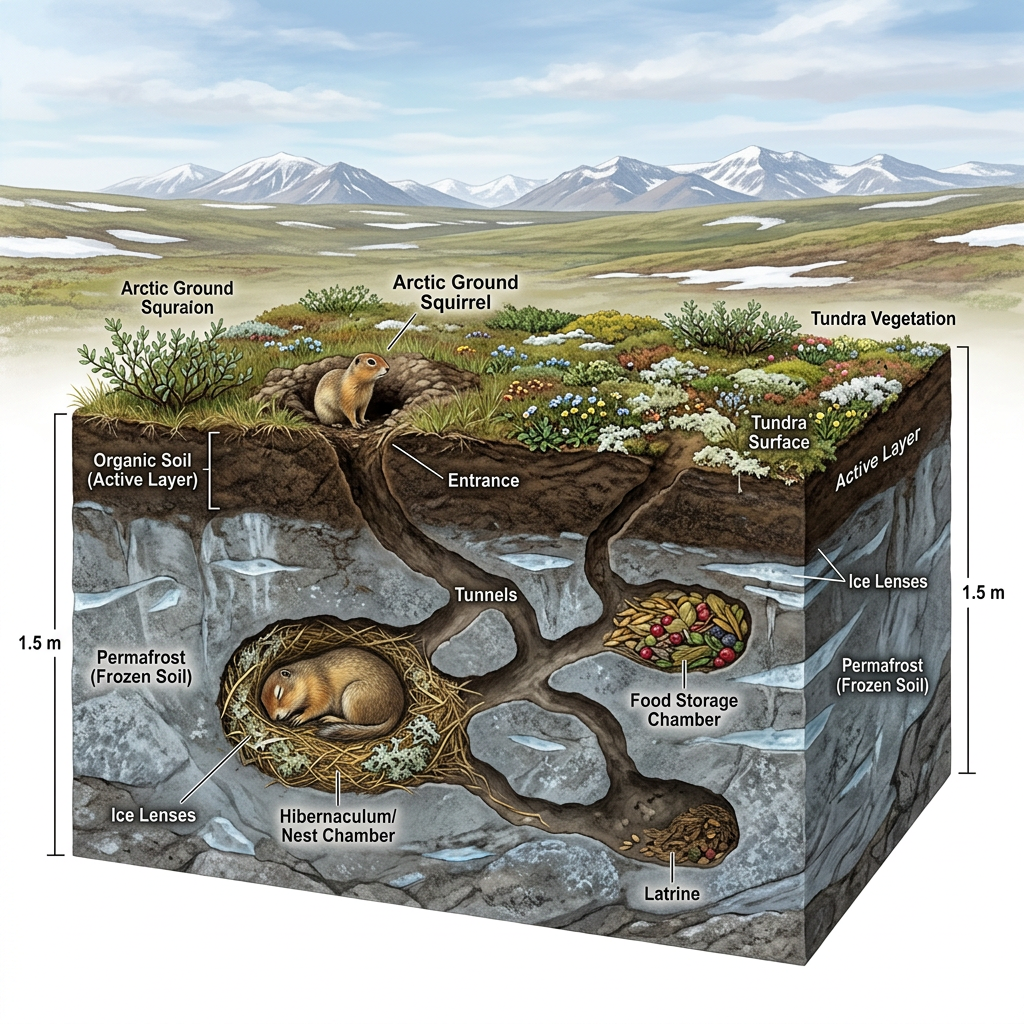
Researchers think Arctic ground squirrels play a role in preserving ancient ecosystems. These animals collect a variety of materials and bring them back to their underground burrows. They gather plant fragments, seeds, bones, fungi, insects and other materials that get trapped within their nests. Because the Yukon permafrost stays frozen for a time these burrows become natural archives.
Ground squirrels also hibernate for up to seven months each year spending much of their lives underground. Their feeding habits are diverse ranging from plants and fungi to insects and small animal remains. This combination of collecting behavior and frozen preservation creates biological records. Scientists found that these fossilized droppings preserved DNA even better than many bones and surrounding permafrost samples. As a result squirrel burrows give researchers a new tool for studying ecosystems from deep time.
Lessons for Today
The importance of this discovery goes beyond understanding animals. Researchers think the genetic information preserved within these samples can help answer questions about how species respond to change.
By examining genes that were influenced by climate shifts scientists may better understand how modern animals and plants could adapt to today’s rapidly warming world.
The study also shows the value of DNA research.
By relying solely on fossils, scientists can now explore entire ecosystems through genetic evidence. According to the researchers the Yukon squirrel burrows likely contain more information than can be analyzed in a single study.
Future investigations may uncover species, evolutionary relationships and environmental changes that shaped life in ancient Beringia.
These tiny fossil droppings have become one of the most valuable biological archives ever discovered, offering a rare window into a world that vanished hundreds of thousands of years ago but still holds important lessons for the future.
Leave a Reply