Last Updated on May 10, 2026 by Jaspreet Kaur
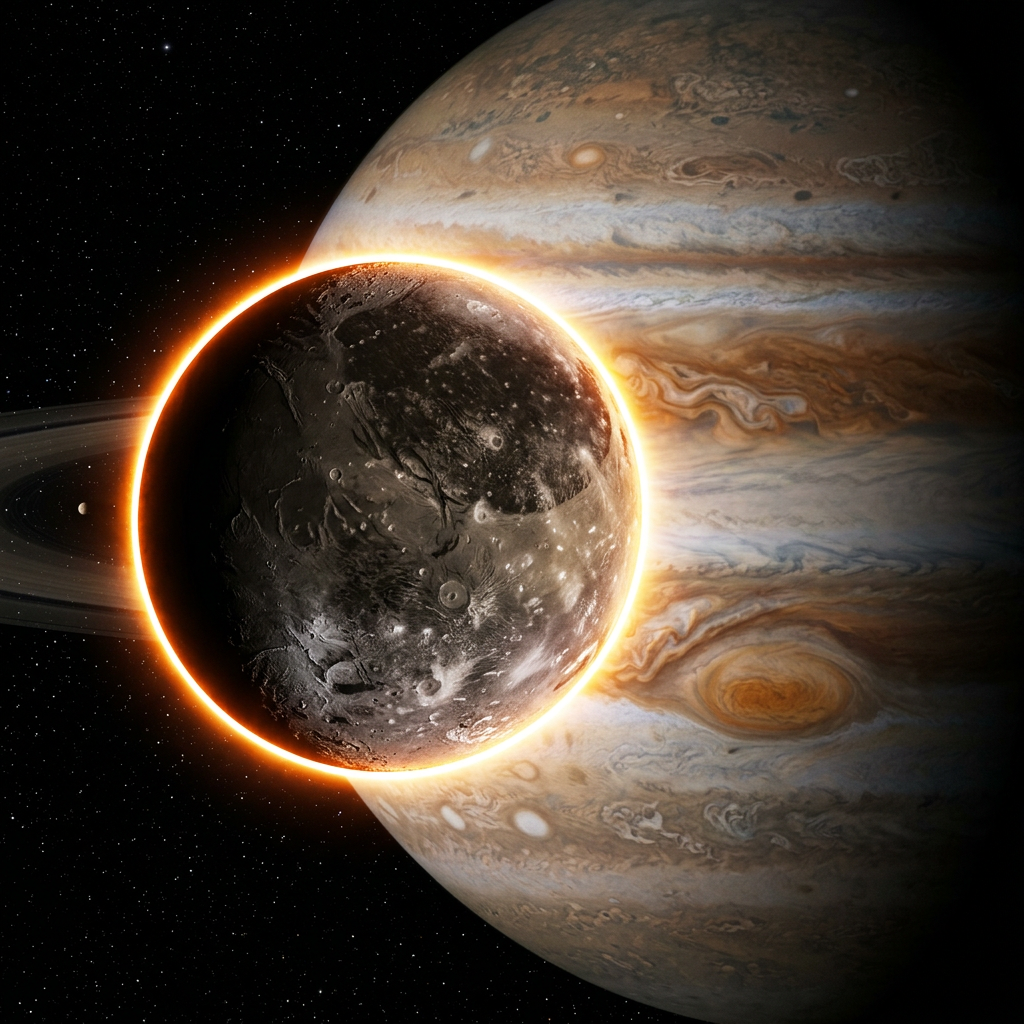
Ganymede, the moon in the solar system, has been fascinating scientists for a long time. It goes around Jupiter. It is even bigger than the planet Mercury. Ganymede is believed to have an ocean under its icy surface.
What makes Ganymede really special is that it is the moon in the solar system that makes its own magnetic field. Among all the moons in the system Ganymede is the only one that has this feature.
Scientists used to think that Ganymede’s magnetic field came from the movement of metal inside its core. However, a new study says that something surprising might be happening deep inside Ganymede. The study suggests that Ganymede’s core may still be forming and this process could be what is making its field.
Magnetic Dynamo
Magnetic fields are made by a process called a dynamo. This happens when molten metal moves around inside a planet or moon. On Earth the movement of metal in the outer core makes the planet’s magnetic field.
Scientists thought that a similar process was making Ganymede’s field. One idea was that iron snow inside Ganymede’s core was making the field. This would happen when solid iron particles form and sink through the metal making the motion that powers the dynamo.
Normally the heat that is needed for this process is made when a planet is first formed. As the planet forms metals like iron sink to the center and make the core. This process usually finishes in a hundred million years. After that the core cools down. The magnetic activity stops.
That is why many moons do not have fields anymore. Even Mars, which is a little bigger than Ganymede, lost its field a long time ago.
So scientists have been trying to figure out why Ganymede still has a field after more than 4.5 billion years. Ganymede is an interesting moon and scientists want to know more about it.
A Cold Start
To try to solve this mystery scientists made computer models of what was happening inside Ganymede over billions of years. They wanted to see what would happen if Ganymede had a start when it was formed. This means that by heating up quickly and making a core right away Ganymede might have warmed up slowly over time.
The models included things like how much water was inside Ganymede, what it was made of and how it was heated by materials and Jupiter’s gravity. The results of the models suggest that Ganymede’s core may still be forming today. Ganymede’s core is still. This process is what is making its magnetic field.
The study says that the heat from materials and Jupiter’s gravity could be slowly warming up Ganymede’s interior. This would make the molten metal keep moving and stirring which would keep the field going. Ganymede’s core is made up of a mixture of iron and sulfur which melts at a temperature more than pure iron. This makes it possible for the core to keep forming over time.
Why It Matters
This discovery could change the way scientists think about how moons and planets evolve. If Ganymede’s core is still forming it would be a process that has never been seen before. The study also shows how different things that happen when a planet is formed can lead to different outcomes billions of years later.
Scientists compared Ganymede to moons like Europa and Callisto. Europa might have been warmer when it was first formed, which would make it less likely to be forming its core. Callisto on the hand might have had a colder start, which would have prevented it from making a strong magnetic field.
Even though Ganymede and Callisto are similar in size and orbit around Jupiter, small differences in what they’re made of and how they were formed might explain why one has a magnetic field and the other does not. Understanding these processes could help scientists learn more about icy worlds in our solar system and beyond.
Looking Ahead
Ganymede is still one of the most interesting objects in the study of planets. Its big ocean, surface and magnetic field make it a great target for future exploration. Scientists hope that upcoming missions to Jupiter’s moons will give them clues about what is happening beneath Ganymede’s surface.
The new research suggests that Ganymede might not just be a frozen moon with a leftover magnetic field. Instead it could still be evolving deep inside. Ganymede’s magnetic field is still a mystery. Scientists want to learn more about it. If this discovery is confirmed it would change the way scientists think about how moons develop and how magnetic fields last for billions of years. For now Ganymede is still a puzzle that scientists are trying to solve. It is a reminder that even the worlds in our solar system can still surprise us. Ganymede is a moon and scientists will keep studying it to learn more about its magnetic field and its core.