Last Updated on July 12, 2026 by Staff
Soft robots are getting more important in fields like medicine and disaster response because they are flexible and can interact with people safely. However, there is a challenge that has limited what they can do. Most soft robots still need sensors and processors to detect forces and respond to their surroundings. These electronic systems make the robots heavier, use energy and can easily fail in extreme environments like deep oceans or areas with strong electromagnetic interference.
Now researchers from the National University of Singapore have developed a soft mechanical force sensor that allows robots to sense and react without using electronics or computer processing. This sensor could pave the way for lighter and more reliable soft robots. The researchers published their findings in Science Advances.
A New Mechanical Sensor
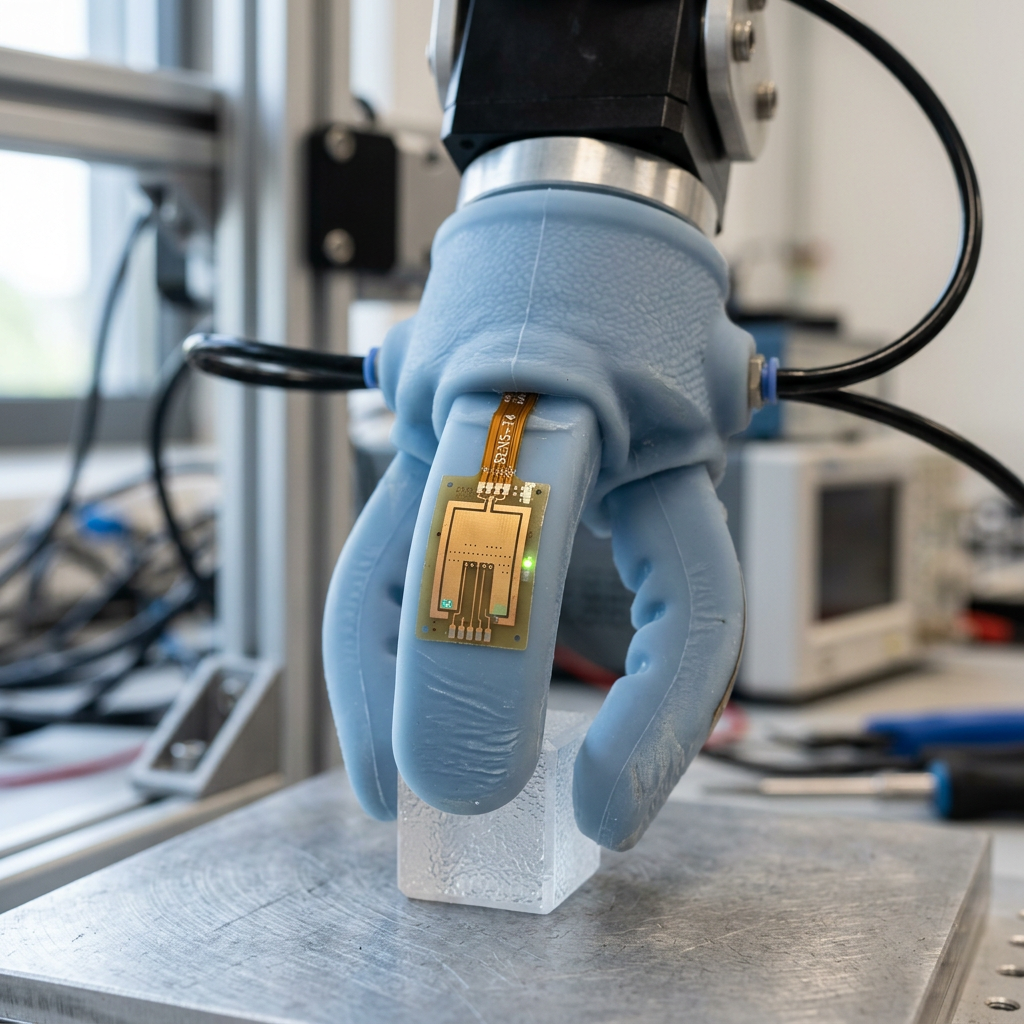
The new device is called the Mechanical Soft Force Sensor. It works entirely through movement and fluid flow. Unlike robotic systems it does not need electrical circuits, batteries or external computing to convert force into action. When pressure is applied to the sensor it directly transforms that force into movement, which then activates the robots soft actuators. This creates a sensing-to-action process without any digital processing.
The Mechanical Soft Force Sensor is really good because it could simplify the design of soft robots and make them more durable in challenging environments. The Mechanical Soft Force Sensor is made using 3D printing. Consists of a soft porous structure with a central pillar connected to five fluid-filled chambers.
The Mechanical Soft Force Sensor can detect forces in three directions. Horizontal, lateral and vertical. This allows robots to accurately determine both the direction and strength of contact. To provide data researchers also integrated a passive electrical mechanism. As the fluid moves magnets past metal arcs small voltage pulses are generated through electromagnetic induction.
Successful Real-World Tests
The research team tested the Mechanical Soft Force Sensor in practical robotic applications. One demonstration involved a robotic glove equipped with five miniature Mechanical Soft Force Sensors. The glove successfully detected gripping forces. Accurately estimated the weight of different objects being held.
The Mechanical Soft Force Sensor was also connected to a haptic feedback device. Participants could feel how tightly the robot was gripping objects and the system allowed users to perform gripping tasks using touch alone. The recorded force signals could later be replayed to teach robots how to repeat grasping actions automatically.
Built for Extreme Conditions
The Mechanical Soft Force Sensor has an advantage. It can function in environments where conventional electronics often fail. The sensor continued working in water heated to 90°C and under water pressure equivalent to around 11 meters below the surface. The Mechanical Soft Force Sensor is also resistant to interference making it suitable for industrial, underwater and medical environments.
Future Potential
According to the research team the Mechanical Soft Force Sensor represents a step toward creating robots that respond almost instinctively to their surroundings. Depending on complex electronic control systems future robots could rely on their own physical structure to sense and react naturally. The Mechanical Soft Force Sensor could be used in training, robotic assistants, advanced prosthetic devices and underwater exploration robots. As researchers continue improving the technology, the Mechanical Soft Force Sensor may help create a generation of intelligent soft robots that are lighter, simpler , safer and capable of operating in places where traditional electronic systems cannot survive. The Mechanical Soft Force Sensor is a step forward for soft robots.