Last Updated on August 9, 2026 by Sanjana Kahol
There is a moment in an apple orchard when the crop is ready and the clock starts running.
For growers, those few days can make the difference between getting fruit to market in good condition and watching part of the crop lose value.
Apples do not all ripen at exactly the same time, and once harvesting begins, thousands of trees may need to be cleared within a window of just a couple of weeks.
For most of the history of commercial apple farming, people have done that work.
A picker reaches into the branches, judges an apple by its color and firmness, twists it from the stem and places it into a bag or bin. It is repetitive, demanding work, but human hands have one major advantage: they can adjust.
A machine cannot always do that.
That is becoming a problem for growers facing higher labor costs and fewer available workers.
Cons of using machines
Machines and robots offer a way around the labor crunch, but there is another question that matters just as much as how quickly they can harvest.
What happens to the apple after the machine touches it?
A review by researchers at Hebei Agricultural University in China examines that question, looking at the injuries caused by different harvesting systems and what those injuries can mean for fruit quality, storage life and, in some cases, food safety.
The harvest window is short
Apples are among the world’s most valuable fruit crops, with global production reaching roughly 94.8 million tons, or about 86 million metric tons, each year.
Getting all that fruit off the trees is expensive. Harvesting can represent 20 to 35 percent of the total cost of growing apples, while an orchard’s harvest period may last only 10 to 14 days.
That puts growers in a difficult position.
They need enough workers to move quickly through the orchard, but agricultural labor has become harder to find in many places. Rising wages add another layer of pressure.
Mechanization is an obvious answer. If a machine can do the work of several people, it could help growers get through the harvest before fruit becomes overripe or weather causes problems.
But apples are not especially forgiving.
An apple is not just an apple
Two apples growing side by side can be at different stages of ripeness. Different varieties behave differently, too.
A human picker can look at an apple, touch it and decide whether it is ready. If the fruit feels delicate, the picker can change how it is handled.
Harvesting machinery has to make those decisions through sensors, programmed movements and mechanical systems.
That is particularly important for apples sold fresh. A fruit headed for a supermarket is expected to look good as well as taste good. A bruise may be enough to send it into a lower grade.
For apples going into juice or cider, the situation is different.
A machine can shake an entire tree and collect the falling fruit without worrying nearly as much about whether every apple remains flawless.
That difference helps explain why there is no single answer to the question of how apples should be harvested.
Four ways to harvest
The review groups harvesting systems into four broad types.
The first is the familiar one: people pick the apples themselves. Manual harvesting remains the gentlest approach overall, although it is not damage-free. Apples can be squeezed too hard, dropped, or knocked against one another as workers fill bags and bins.
The second approach is vibration harvesting. Machinery shakes the trunk or branches, causing apples to fall into catching systems.
It is fast. It is also rough.
Then there are harvest-assist platforms. Instead of replacing the picker, these machines make the job easier by carrying workers through the orchard at a convenient height while helping move and sort the fruit.
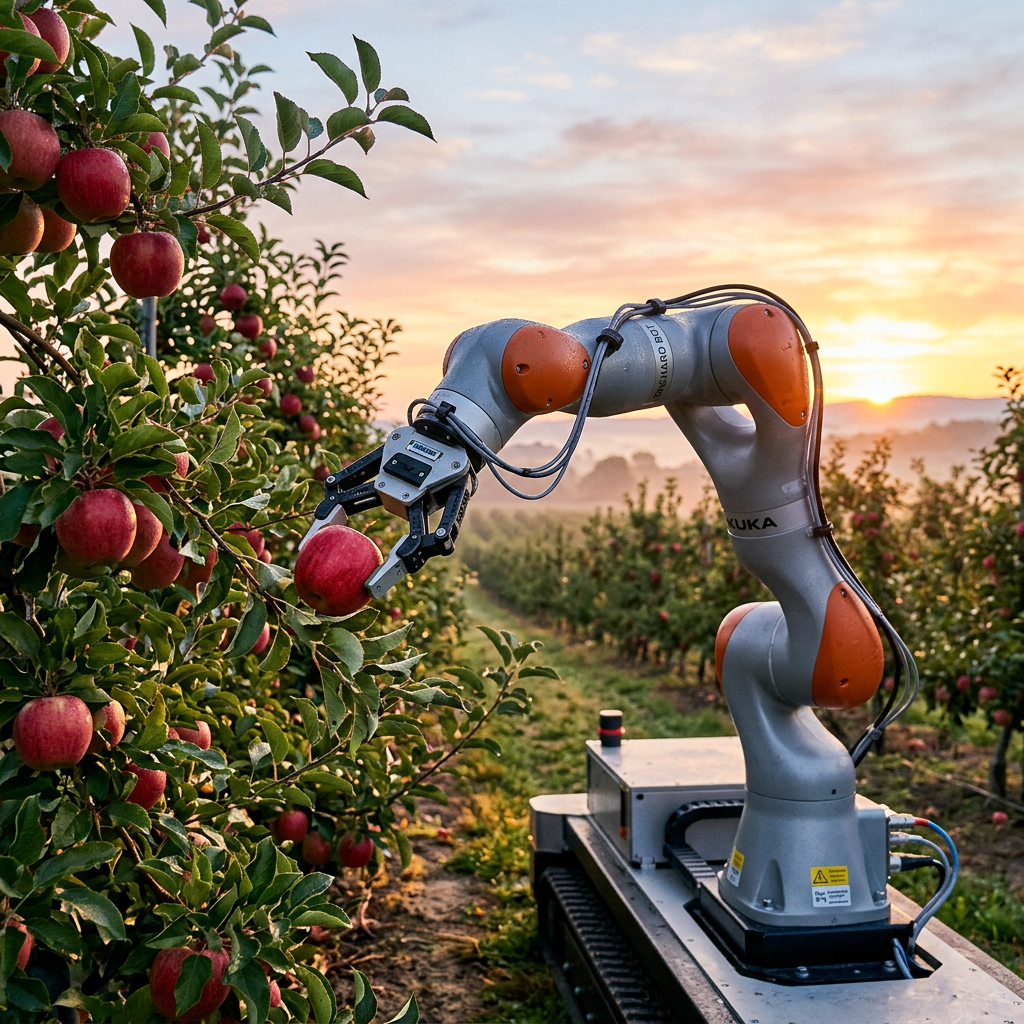
The most technologically ambitious option is selective robotic harvesting. Cameras and other sensors identify ripe apples, while robotic arms attempt to remove them individually.
That sounds like the closest approach to a mechanical version of a human hand.
The technology is not quite there yet.
Machines leave different marks
The researchers use the term “damage profile” to describe the types and amounts of injury associated with each harvesting method.
Vibration harvesting came out poorly when the goal was top-quality fresh fruit. Under well-optimized conditions, about 85 percent of apples still qualified for the highest USDA grade.
That means roughly 15 percent were downgraded because of problems such as bruising, cuts or torn stems.
Harvest-assist platforms produced much better results in some studies. When advanced platforms were paired with sorting in the orchard, bruising-related downgrades were reported as low as 0.4 percent.
Robotic harvesting is somewhere in between.
Recent trials found that selective robots picked ripe fruit correctly on their first attempt about 80 percent of the time. Roughly 91 percent of the apples harvested in those trials retained top grade.
There is a catch.
A robot may need six to eight seconds to pick one apple. A human picker can move considerably faster.
So the problem is not simply getting robots to pick fruit. They need to pick it accurately, gently and quickly enough to justify their use.
Damage can hide at first
One of the more interesting points in the review is that harvest damage is not always obvious on the day it happens.
An apple can look fine after being picked and still contain injured cells.
When tissue is crushed or cut, the normal barriers inside the cells are disrupted. Oxygen and enzymes that are usually kept apart can meet, producing reactive oxygen molecules and setting off a series of chemical reactions.
The brown patch that eventually appears on a bruised apple is part of this process.
Apples contain phenolic compounds, which are natural plant chemicals. They are normally separated from an enzyme called polyphenol oxidase. When cells are damaged, the two come into contact and a reaction produces the familiar brown color.
This is why a small injury can seem to get worse with time.
The problem for growers is that a quick inspection immediately after harvesting may not reveal everything that happened to the fruit. Some injuries become visible only after the apples have spent days or weeks in storage.
By then, the machine that caused the damage is long gone.
A cut can change everything
Bruising affects appearance and storage quality, but a deeper injury can have another consequence.
It can give microorganisms a way inside.
One fungus is particularly important in stored apples: Penicillium expansum. It causes blue mold rot and is the main source of patulin, a toxin that is closely watched in apple products.
Healthy apple skin is a remarkably effective barrier. Penicillium expansum generally needs an opening, such as a cut, puncture or damaged stem, before it can invade the fruit.
That creates a connection between what happens in an orchard and what happens much later in the food supply chain.
A rough harvesting method may cause an injury that is almost impossible to see at first. During storage, the damaged area can become infected. The fungus can then grow and produce patulin.
The food-safety issue therefore does not necessarily begin in a processing plant. It can begin with a small mechanical injury made weeks earlier.
The toxin is already regulated
Patulin is regulated in apple juice and other apple products because it can cause adverse health effects, including nausea.
In the United States, the Food and Drug Administration has set an action level of 50 micrograms per kilogram, or 50 parts per billion, for patulin in apple juice.
That number is important, but it does not mean every bruised apple is a safety threat.
Most injuries do not automatically lead to fungal contamination. The concern is that certain types of damage make infection more likely.
A bruise, a scrape and a deep puncture are not biologically equivalent.
That distinction is one reason the researchers argue that harvest systems should be judged by more than the amount of fruit they collect.
Speed is not the whole story
The review proposes two conceptual measures, called the Damage Risk Index and the Harvest Suitability Score.
The idea is fairly straightforward. A harvesting system should be assessed using several factors at once, including how quickly it works, how much damage it causes, how much marketable quality is lost and what risks may arise during storage.
A shallow surface mark might lower an apple’s appearance grade. A puncture can do more because it breaks the fruit’s protective barrier.
The authors do not present these scoring systems as finished tools. They describe them as illustrative frameworks based on findings from different studies rather than a single controlled experiment.
Still, the approach raises a useful question.
Instead of asking which harvesting machine is fastest, growers could ask which machine makes the most sense for the particular apples they are trying to sell.
The destination matters
An apple grown for a supermarket does not have exactly the same requirements as an apple grown for a juice processor.
That could become increasingly important as farms adopt different forms of automation.
A rougher harvesting system might make sense for fruit that is going straight into processing. For premium fresh-market apples, a slower system that causes fewer injuries could be worth the extra time.
Sorting could also play a bigger role.
If fruit can be assessed immediately after harvesting, growers may be able to separate the least damaged apples for fresh markets while directing more heavily injured fruit toward processing.
The challenge is knowing how much damage is actually present.
The evidence has gaps
The review does not claim to have settled the question.
One reason is that the researchers had to compare results from many different studies. Those studies did not all use the same apple varieties, orchard conditions, harvesting equipment or methods for measuring damage.
That makes direct comparisons difficult.
A better experiment would start with apples from the same orchard and follow them for weeks after harvest. Researchers could use the same measurements for firmness, bruising, decay and toxin levels, then compare what happens under each harvesting method.
Such an experiment could reveal something that a harvest-day inspection cannot.
It could show which injuries matter later.
Automation still has a future
None of this means machines are a bad idea.
Apple growers have practical reasons to automate. Labor is expensive, workers can be difficult to find, and the harvest window is short. For many farms, doing nothing is not necessarily an option.
The question is what kind of automation makes sense.
A useful harvesting machine may eventually need to do more than identify an apple and pull it from a branch. It will need to recognize ripeness, understand how firmly it can grip different fruit, avoid damaging the skin and move quickly enough to keep pace with commercial harvesting.
That is a much harder engineering problem.
But it is also where the science of apple harvesting is heading.
The most important measure of a machine may not be how many apples it can collect before sunset. It may be how many of those apples are still healthy, marketable and safe several weeks later.
The study is published in the journal Foods.

Leave a Reply